Hygiene between clients: what has to be single-use and what does not

Hygiene in a nail service is not complicated, but it is unforgiving, and the rules follow from one physical property: whether an item can be fully cleaned. Sorting your station by that question makes the routine obvious and much faster than trying to remember item-by-item rules.
Porous items cannot be disinfected, so they are single-use
Anything that absorbs — files with a foam or paper core, buffer blocks, wooden sticks, cotton, toe separators made of foam — takes liquid and debris into its structure. Surface disinfection cannot reach that, so there is no reliable way to make it safe again.
These items are consumables. Treating them as such is why disposable kits exist and why they are priced to be thrown away.
Non-porous metal tools are cleanable, in a defined sequence
Steel implements can be cleaned and disinfected properly because nothing penetrates the surface. The sequence matters: physically clean off debris first, because disinfectant cannot work through a layer of dust and product.
Clean, then disinfect for the full stated contact time, then rinse and dry. Skipping the cleaning step is the most common error, and it makes the disinfection step largely decorative.
Contact time is not a suggestion
Every disinfectant specifies how long it must remain wet on the surface to work. Wiping something over and drying it immediately achieves very little regardless of how strong the product is.
Building the timing into the workflow — tools go in while you do something else — is easier than trying to time it precisely, and it means the step never gets shortened when you are busy.
The station surface matters as much as the tools
Dust from filing settles on everything within reach, and a table mat is in contact with clients repeatedly. A wipeable, non-porous surface that is cleaned between clients is doing real work.
Washable microfibre or PU mats are practical because they can be cleaned properly; a fabric mat that cannot be cleaned to the same standard is a weak point in an otherwise good routine.
Drills need their own routine
Bits are non-porous and can be disinfected like other metal tools. The handpiece itself cannot be immersed, so it is wiped down, and the vents need keeping clear of dust because that is where debris accumulates.
Keeping several sets of bits so a set can be in the disinfection cycle while another is in use is what makes this practical during a busy day.
Organise the station so the clean route is the easy route
If the disinfected tools are further away than the used ones, the routine will erode under time pressure. Position the clean storage where your hand naturally goes.
A used-tool tray that leaves the station in one movement, and a clean roll that opens in front of you, removes almost all of the friction. Hygiene routines survive when they are the path of least resistance.
Consumables and reusables here
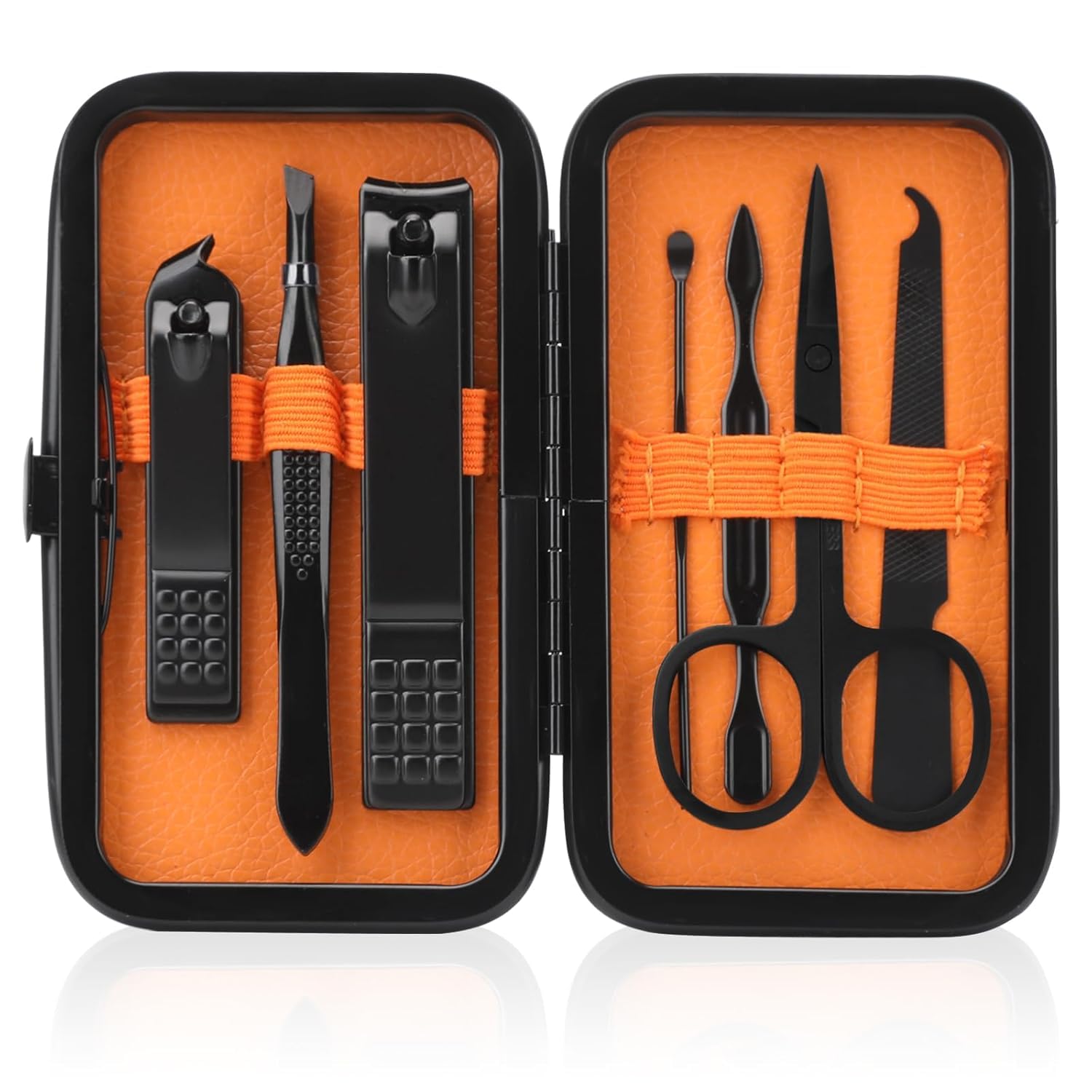
The disposable kits on this shelf cover the single-use side, and the steel implements cover the side that can be cleaned and kept. On our own shelf that range currently runs from $7.99 for the fenlebeneil 7-Piece Black & Orange Manicure Set for Men & Women up to $7.99 for the fenlebeneil 7-Piece Black & Orange Manicure Set for Men & Women.
The items here all live under Manicure Pedicure Kits — 1 product at the moment. What you see here is what checkout charges — nothing is added at the last step.
Related reading
Two other pieces on this site cover ground next to this one. Almost every uncomfortable drill experience is a heat problem, and heat comes from pressure and dwell time rather than from speed alone. And on a related note, the difference between doing your nails occasionally and doing them well is usually the setup, not the skill.
- Cordless nail drills: speed, torque and the mistakes that cause heat
- Setting up a home manicure station that is actually pleasant to use
Where routines break down in practice
Under time pressure, almost always at contact time. A tool wiped and put straight back into service has been cleaned rather than disinfected, and the difference matters because the contact time is what the product was tested at.
The other common failure is the shortcut of disinfecting without cleaning first. Disinfectant cannot penetrate a film of dust and product residue, so a visibly dusty implement dropped straight into solution comes out no safer than it went in.
Records and what clients notice
Keeping a simple log of which batch of solution was mixed when is unglamorous and it is what makes a routine defensible if anyone ever asks. Disinfectant solutions have a working life and lose effectiveness once contaminated.
Clients notice more than people expect. Opening a sealed disposable kit in front of somebody, and taking implements from a visibly clean storage roll rather than a drawer, communicates the standard far more effectively than any certificate on a wall.
The one question to ask
Before every item goes back in a drawer, ask whether it absorbs. If it does, it is a consumable and it goes in the bin. If it does not, it gets cleaned, disinfected for the full contact time, dried and stored. That single question covers almost every case.
Orders leave our counter in Los Angeles, CA at $4.50, or free once you pass $35. You have 30 days to return anything unused. [email protected] reaches us.